
The Informed View of Australian Property and Lessons for Buyers
Australia's property market has experienced plenty of changes in the past few months, but things look even more dynamic when we take a longer view over the past few decades.
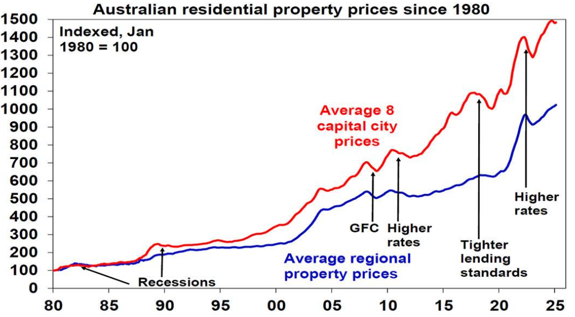
From the high interest rates of the 1980s and the recession of the early 1990s to the Global Financial Crisis, tighter lending conditions and the more recent interest rate cycles, property prices have responded to a wide range of economic pressures.
Yet, despite these periods of uncertainty, the Australian property market has demonstrated a remarkable capacity to recover and grow, often at quite rapid speeds.
With property prices currently changing across the country, it's worth examining what previous downturns tell us about the market and what buyers can learn from them.
PEAKS AND TROUGHS OF THE LAST 40 YEARS
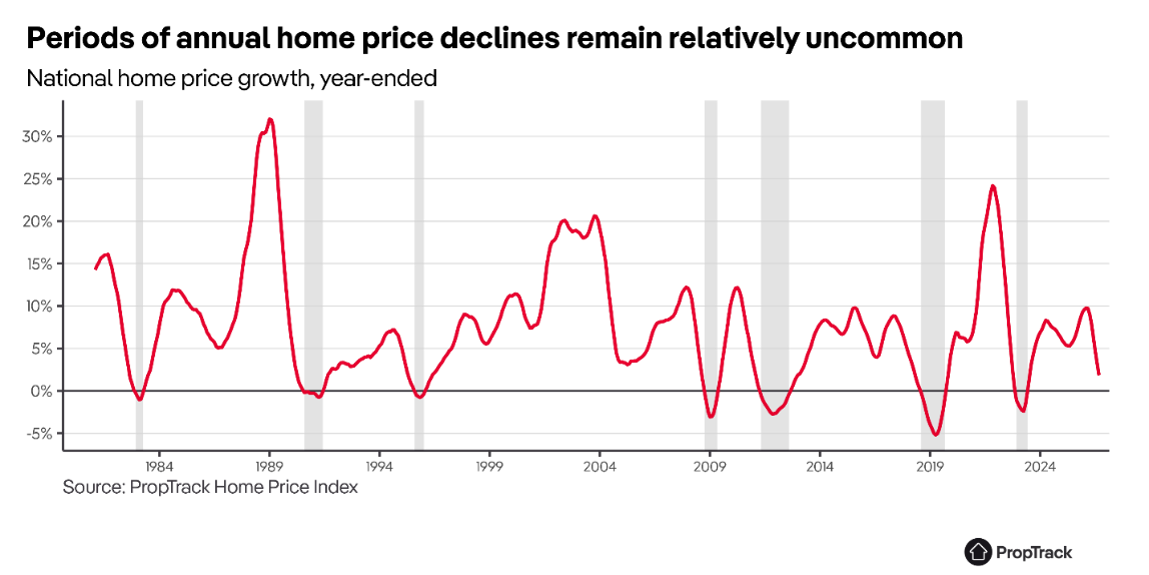
One of the more interesting features of Australia's property market is that sustained national price declines haven't occurred. According to PropTrack's analysis of more than 40 years of property data, Australia has experienced 14 previous periods where national property prices fell below their previous peak and then recovered.
However, only seven of those downturns resulted in price declines greater than 1%, and none exceeded 6% nationally.
Some of the more significant downturns included:
- 2008, Global Financial Crisis: National property prices declined by 3.5%.
- 2010–2011: Prices fell by 3.1% as affordability pressures and economic conditions weighed on demand.
- 2018–2019: Tighter lending conditions contributed to a 5.3% national decline.
- 2022: Rapidly rising interest rates reduced borrowing capacity, contributing to a 3.6% fall.
The current downturn is different to previous events. By September 2026, national property prices had declined 3.3% from their March peak, according to PropTrack. Although this wasn't an unusually large fall compared with previous cycles, the rate of decline was faster than in earlier national downturns.
Source: PropTrack historical property price data.
These figures illustrate an important distinction. The speed of a downturn doesn't automatically determine how severe it will become. Some market corrections have occurred relatively quickly, while others have unfolded over several years. The circumstances driving each downturn have also been different.
WHAT CAUSES PROPERTY PRICES TO FALL?
Property downturns are usually driven by a combination of factors including interest rates, lending conditions, employment, government policy and buyer sentiment.
The 2018–2019 downturn was influenced by tighter lending conditions where the banks restricted their lending practices, while rapid interest rate increases were a major factor in the 2022 decline.
Higher interest rates have again affected the current market, though the 2026 decline was accelerated by changes to negative gearing and capital gains tax which have led to market confusion and uncertainty.
However, property prices aren't determined by what buyers want to pay. They're also influenced by what buyers can afford and what sellers are prepared to accept.
When borrowing capacity falls, buyers have smaller budgets, while sellers who don't need to move can choose to wait rather than accept lower offers. These competing pressures can produce very different outcomes across individual markets.
NOT ALL PROPERTY MARKETS MOVE TOGETHER
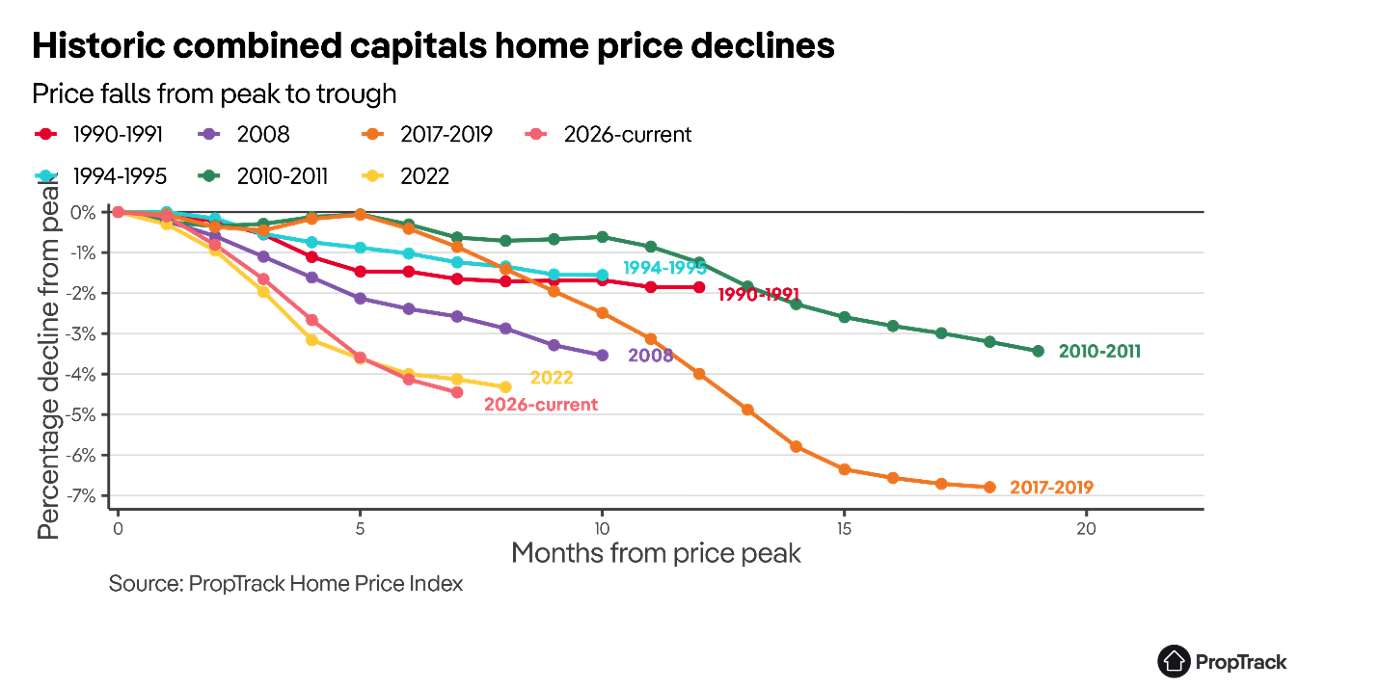
National property statistics combine thousands of local markets that don't move in the same direction or at the same pace. For example, looking at PropTrack's data for the current downturn, national prices declined 3.3% from their March peak, but the falls were more pronounced in Sydney and Melbourne.
Sydney prices were down 5.5% from their November 2025 peak, Melbourne had fallen 5.7% from October 2025, while Brisbane recorded a 4.1% decline over six months.
Previous downturns have also varied. Sydney experienced an 11.3% decline between 2017 and 2019, while Melbourne's early 1990s downturn extended over 32 months.
But even city-wide figures only tell part of the story. Individual suburbs, streets and property types can experience very different levels of demand.
A well-located family home in a tightly held neighbourhood can still attract strong competition, while nearby apartments struggle to find buyers. Properties with undesirable features, maintenance issues or compromised locations (such as busy streets) can also experience greater price pressure.
That's why it's important to distinguish between the performance of the overall market and the value of an individual property.
INSIGHTS FROM PROPERTY MARKET RECOVERIES
The same principle applies during recoveries. When the market bounces back, eventually all properties will increase though some properties will lag behind. Once again, it’s important to assess the property while considering the market environment.
Many people will try to wait out a ‘hot’ market, instead of buying when the time is right for them and then selecting a property where capital growth is about to arrive, or where they can create significant value.
The chart below shows the overall price of prices nationally, however there’s extreme variation as well as opportunities along the trend line.
Source: Bank for International Settlements (BIS). Chart: The Australia Institute, 2025.
One of the most useful lessons from previous downturns is that market recoveries don't always begin when economic conditions look encouraging. Property markets are forward-looking, and buyer behaviour can change before the broader economic picture has improved.
For example, the 2022 downturn was followed by a recovery despite interest rates remaining elevated. Limited housing supply and renewed buyer competition forced prices to move higher again.
The length and strength of a recovery depends on the economic conditions, housing supply, demand and lending environment at the time, and there's also a difference between a market recovering and an individual property recovering its value.
Properties purchased at inflated prices, or those with significant drawbacks, can take considerably longer to regain their previous value.
Some properties can also underperform the broader market for extended periods, even when national prices are increasing, but the key point is long-term market growth doesn't eliminate the consequences of buying poorly.
A MARKET CORRECTION ISN'T A PROPERTY CRASH
Falling property prices naturally generate concern, particularly when declines happen quickly. However, there's a big difference between a market correction and a serious housing downturn. A correction can occur when borrowing capacity declines, demand weakens or prices adjust following a period of strong growth.
A more severe downturn is associated with additional pressures such as rapidly rising unemployment, over supply of available housing, widespread mortgage stress and forced property sales.
Although Australia's labour market has softened, we continue to face limited housing supply and have a large and growing buyer pool. This will buffer prices from falling to extreme levels.
To determine when the current soft market will end, employment rates, interest rates, housing supply and lending activity will be the leading indicators rather than price performance charts.
WHAT DOES THIS MEAN FOR PROPERTY BUYERS?
Historical property data is useful, but buying decisions need to be based on much more than whether prices are rising or falling.
There’s several important lessons buyers can take from previous market cycles.
- A falling market doesn't automatically mean you're getting a bargain
When property prices decline, buyers can assume they're getting better value simply because they're paying less than they would have six months earlier.
But a lower price doesn't automatically represent good value. For example, a property that was originally marketed at $1.5 million but was only realistically worth $1.35 million. If the asking price subsequently falls to $1.4 million, the property is still overpriced, despite the apparent $100,000 reduction.
The comparison isn't what the seller originally wanted or what a similar property sold for at the peak of the market. It's what the property is worth under current conditions, taking into account its location, condition, features, comparable sales and future prospects.
- The best properties can still attract competition
Even in a softer market, quality properties can generate considerable buyer interest. Well-located homes with desirable features, good layouts and limited competing supply can continue to perform strongly.
This creates a situation where buyers might have greater negotiating power across the broader market but still face competition for the properties they most want to purchase. So it's important to recognise these differences rather than assume every seller will be prepared to negotiate.
- Market conditions can change the balance of negotiating power
One of the more useful aspects of a softer market is that buyers can have more choice and greater negotiating opportunities. When properties take longer to sell, vendors can become more receptive to offers, particularly if they have already purchased elsewhere or need to sell within a particular timeframe.
But the opportunity isn't just about negotiating a lower purchase price. In softer markets, buyers can also have greater scope to negotiate settlement periods, contract conditions and other terms that suit their circumstances.
Understanding the seller's position, the level of competing buyer interest and the property's realistic value can make a substantial difference to the outcome.
- Buying at the bottom of the market isn't a reliable strategy
It's tempting to wait until prices have reached their lowest point before making a purchase. The difficulty is that market bottoms are only obvious in hindsight, because by the time the data confirms prices are rising again, buyer competition has already increased.
That doesn't mean buyers should ignore market conditions or rush into a purchase, though it does mean buyers should focus on what they can assess and control, rather than trying to predict exactly when the market will turn.
No matter what the market is doing, buyers should primarily focus on purchasing a good property at a price that represents value, with the aim of holding the property through changing market conditions until it's the right personal time to sell.
- The quality of the property matters long after the market cycle has changed
Market downturns eventually pass, but the characteristics of a property remain. A poor layout, problematic building, undesirable location or expensive maintenance issue doesn't disappear when prices begin increasing again.
These factors impact rental returns, resale demand, ongoing ownership costs and long-term capital growth. A discount on the purchase price can quickly lose its appeal if the property creates significant costs or delivers disappointing performance over the longer term.
MAKING THE MOST OF TODAY'S PROPERTY MARKET
The current market slowdown has created changing conditions for buyers across Australia's major property markets. In some locations, increased listings and reduced competition are giving buyers more choice and greater negotiating power.
In others, quality properties remain tightly held and competition continues despite softer headline price figures. The important point is that there isn't one Australian property market, and there isn't one buying strategy that works for every property.
If you’re buying your home, the focus needs to be on finding a property that meets your requirements, represents good value and can accommodate your changing needs.
If you’re buying an investment property the assessment needs to go further, incorporating rental demand, holding costs, potential capital growth, future supply and the property's contribution to your broader financial objectives.
In both situations understanding the current market is important, but so is knowing when to negotiate, when to compromise and when to walk away.
THE INFORMED VIEW
Four decades of property data demonstrates that market downturns are part of Australia's property history, even if sustained national price declines have been relatively uncommon.
The causes, duration and severity of those downturns have varied considerably, and the performance of individual cities and local markets hasn't been uniform.
Similarly, while the timing and strength of market recoveries is far from predictable, for today's buyers, the most useful lesson isn't that property prices will eventually rise again. It's that market conditions are only one part of a successful property purchase.
Understanding what you're buying, what it's worth, how it compares with other opportunities and how it fits your longer-term objectives will have a much greater influence on the outcome than attempting to predict the next market movement.
The best buying decisions are made by understanding both the market and the property, and knowing how to make the two work together so it all works for you.
About the Author
Debra Beck-Mewing is the CEO of The Property Frontline and Editor of Property Portfolio Magazine. With over 20 years of experience buying property across Australia, Debra is a skilled property strategist and buyers agent known for uncovering tailored opportunities — from family homes to multi-use investments.
She has deep expertise in advanced strategies including renovations, granny flats, sub-division, and development. A Qualified Property Investment Advisor (QPIA®), licensed real estate agent, and holder of a Bachelor of Commerce and Master of Business, Debra combines strategic insight with hands-on experience.
Debra is the creator of the Property Smart Track System™ – a professional property buying system that enables buyers to select, assess and buy property independently in today's market. She also leads Buy Like A Genius™, a premium end-to-end buyers’ agency service for busy professionals seeking expert property acquisition without the stress.
As a passionate advocate for greater transparency in the property and wealth industries, Debra is a sought-after speaker, author, podcast host, and participates on numerous committees including the Property Owners’ Association.
Download your guide
Start Buying - Stop Crying
There’s plenty of opportunities if you’re trying to buy a property in the current market, and the news gets better if you qualify for financial assistance packages.
DON'T GUESS, STRESS OR OVERPAY
Learn how to turn the market in your favour no matter where it heads next, by using the tips included in our guide.
We hate SPAM. We will never sell your information, for any reason.